
↓Hybrid Electric Scrubber
- →Hybrid Wet Electric Scrubber Working Principle and Comparison
- →A Novel Hybrid Scrubber Electrochemically Air Purify & Dust Removal
- →innovation Hybrid Wet Electrochemical Scrubber
- →Features of hybrid electrochemical scrubber apparatus
- →Structural Improvement and Performance Evaluation of a Hybrid Electrochemical-Wet Air Purification and Dust Removal Device
- →Hybrid Electrochemical Scrubber Apparatus Redefining Industrial Environmental Protection for the Next Decade
- →World-class environmental governance solutions
- →When the Hybrid Electrochemical Scrubber Apparatus encounters cutting-edge technology
- →AeroHydro ElectroClean™
- →Discussion on the Principles and Applications of Hybrid Electrochemical Scrubber Apparatus
- →Exploring the Hybrid Electrochemical Scrubber Apparatus
- →Unique composite Hybrid Electrochemical Scrubber Apparatus
- →A Next-Generation Environmental Protection Solution Integrating Physics-Informed AI and Digital Twin
- →Celebrating our 64th anniversary: The intelligent Hybrid Electrochemical Scrubber Apparatus (HESA)
- →Stop Believing “Bigger Vortices Are Better”: Industrial Air Pollution Control Is Entering a High-Energy, Inefficient Arms Race
Stop Believing “Bigger Vortices Are Better”: Industrial Air Pollution Control Is Entering a High-Energy, Inefficient Arms Race
While the Entire Market Competes Over “How Large the Vortex Is,” the Real Problems Are Being Ignored
In recent years, vortex-based wet scrubbing systems have become one of the dominant technologies in the industrial air pollution control market. Across industries such as semiconductors, metal processing, chemicals, printing, and even food manufacturing, many companies instinctively turn to large-scale vortex scrubbers when dealing with dust, oil mist, and VOCs (Volatile Organic Compounds).
However, an important question is beginning to emerge across the industry:
“Is a larger vortex really better?”
What is increasingly concerning is that many systems on the market are falling into a dangerous pattern of technological homogenization. Numerous manufacturers now treat “vortex size” as the primary indicator of performance, while overlooking the factors that actually determine treatment efficiency:
• Whether airflow remains stable;
• Whether gas-liquid contact is evenly distributed;
• Whether atomization is sufficiently fine;
• Whether electrochemical reactions genuinely occur;
• Whether system pressure loss and energy consumption are minimized;
• Whether wastewater is properly treated.
These are the factors that truly determine the effectiveness of industrial air pollution control systems.
The Biggest Misconception in Industrial Air Treatment: Treating “Vortex” as the Only Solution
A common issue found in many imitation or low-cost systems currently on the market is this:
In Pursuit of “Larger Vortices,” They Actually Create More Turbulence
At first glance, high-speed vortices appear to improve gas-liquid mixing efficiency. However, without proper fluid dynamics design and flow-field control, the opposite often occurs.
Excessively chaotic vortex flows can easily result in:
• Airflow short-circuiting;
• Localized high-pressure zones;
• Uneven water mist distribution;
• Insufficient contact time;
• Excessive pressure drop.
The final outcome is often straightforward:
“Power consumption increases dramatically, yet pollutants are still not effectively removed.”
This explains why many factories experience the following problems over time:
• Rising electricity costs;
• Increasingly oversized scrubber towers;
• More frequent maintenance requirements;
• Growing wastewater treatment difficulties;
• Unstable emission performance.
Although the equipment appears to be operating normally, a significant portion of energy is actually being wasted on ineffective turbulence and poor system design.
The Overlooked Problem: Many Systems Are Simply “Relocating Pollution”
An even more serious issue is that some low-end or imitation systems create substantial secondary pollution problems.
Many systems are capable of temporarily “washing pollutants into water,” but lack the downstream treatment capability required to properly process the contaminated liquid.
As a result:
“Air pollution simply becomes wastewater pollution.”
This issue is especially common in:
• Oil mist treatment;
• High-concentration VOC processes;
• Ammonia-containing exhaust streams;
• Organic solvent manufacturing processes.
Without effective electrochemical oxidation, solid-liquid separation, and recirculation treatment mechanisms, pollutants ultimately remain in the circulating water system, often leading to odors, sludge accumulation, and high-COD wastewater.
This not only increases downstream wastewater treatment costs, but also conflicts with modern industrial expectations regarding:
• Energy conservation and carbon reduction;
• Cleaner production;
• Wastewater minimization;
• Environmental compliance.
Why Is the Industry Beginning to Focus on “Multi-Field Coupling Treatment”?
As conventional scrubbing systems continue to encounter technical limitations, the industry is gradually realizing:
Effective pollution control cannot rely on vortex generation alone.
The next generation of industrial pollution control technology is shifting from a “single scrubbing mechanism” toward:
“A multi-field coupling architecture integrating fluid dynamics, micro-atomization, electrochemical oxidation, and dual-film mass transfer.”
This is one of the major reasons why the Hybrid Electrochemical Scrubber Apparatus (HESA) has recently attracted growing attention.
HESA Does Not Simply “Build Bigger Vortices” — It Redesigns the Entire Reaction Mechanism
Unlike many imitation systems currently available on the market, HESA is not focused on creating larger vortex structures.
Instead, its core objective is:
“Ensuring that every droplet, every airflow pathway, and every electrochemical reaction occurs effectively.”
Its primary technical features include:
1. Flow Stabilization Design: Reducing Turbulence and Pressure Loss
Rather than pursuing uncontrolled high-intensity vortices, HESA first stabilizes and equalizes airflow through pressure-balancing and flow-reduction design.
This approach effectively reduces:
• Local turbulence;
• Energy waste;
• Pipeline fatigue;
• Pressure loss.
For large industrial facilities, the long-term reduction in blower energy consumption can be highly significant.
2.Multi-Layer Parallel Electrode Arrays: Increasing Effective Reaction Surface Area
Many conventional systems merely “rotate the airflow.”
HESA, however, focuses on a more critical question:
“Do pollutants actually reach the reaction zone?”
Through its multi-layer parallel electrode array design, HESA divides large-volume chaotic airflow into multiple stable reaction channels.
This not only improves gas-liquid contact uniformity, reduces turbulence-related pressure loss, and extends retention time, but also significantly enhances electrochemical oxidation efficiency.
3.Micron-Level Atomization: Enhancing Dual-Film Mass Transfer Efficiency
Effective scrubbing is not simply about “adding water.”
The key factors are:
• Whether droplets are sufficiently fine;
• Whether contact surface area is maximized;
• Whether mass transfer time is sufficient.
HESA utilizes the interaction between exhaust gas, water mist, multi-layer parallel electrode plates, vortex shear forces, and electric-field coupling to further refine droplets into micron-scale mist.
This substantially improves pollutant absorption and degradation performance.
This differs fundamentally from many conventional systems that rely only on coarse spraying mechanisms.
4.Electrochemical Oxidation: Not Just Capturing Pollution, but Breaking It Down
Many traditional systems only achieve:
“Pollutant collection.”
HESA instead emphasizes:
“Whether pollutants can be further decomposed.”
Through electrochemical oxidation and hydroxyl radical reactions, certain organic pollutants can be further degraded instead of merely remaining trapped within the circulating water system.
This represents one of the most significant technological distinctions between HESA and traditional scrubbing equipment.
🧩 Technical Comparative Analysis:Traditional Scrubbing Equipment VS HESA Multi-Field Coupling System
1
The Real Challenge Is Not Whether Equipment “Looks Powerful,” but Whether It Can Operate Reliably Long-Term
In real industrial environments, the most difficult challenge is rarely short-term compliance.
The real questions are:
• Can the system remain stable over the long term?
• Will energy consumption become uncontrollable?
• Will maintenance burdens continuously increase?
• Will wastewater accumulation become unmanageable?
• Can emission performance remain consistently stable?
This is why the industry is gradually shifting from pursuing “single-point equipment performance” toward prioritizing:
“Overall system efficiency and long-term operating cost.”
Industrial Air Pollution Control Is Evolving from “Equipment Competition” to “System Competition”
In the future, the most competitive systems may not be those with the largest vortices.
Instead, they will be the systems that best understand:
• Fluid flow control;
• Mass transfer efficiency;
• Electrochemical reactions;
• Energy reduction strategies;
• Secondary pollution prevention.
This signals that industrial pollution control is moving beyond traditional mechanical equipment thinking and entering a new era of:
“Multi-field coupling and systems engineering.”
And this transition may ultimately become the true turning point for the industry.
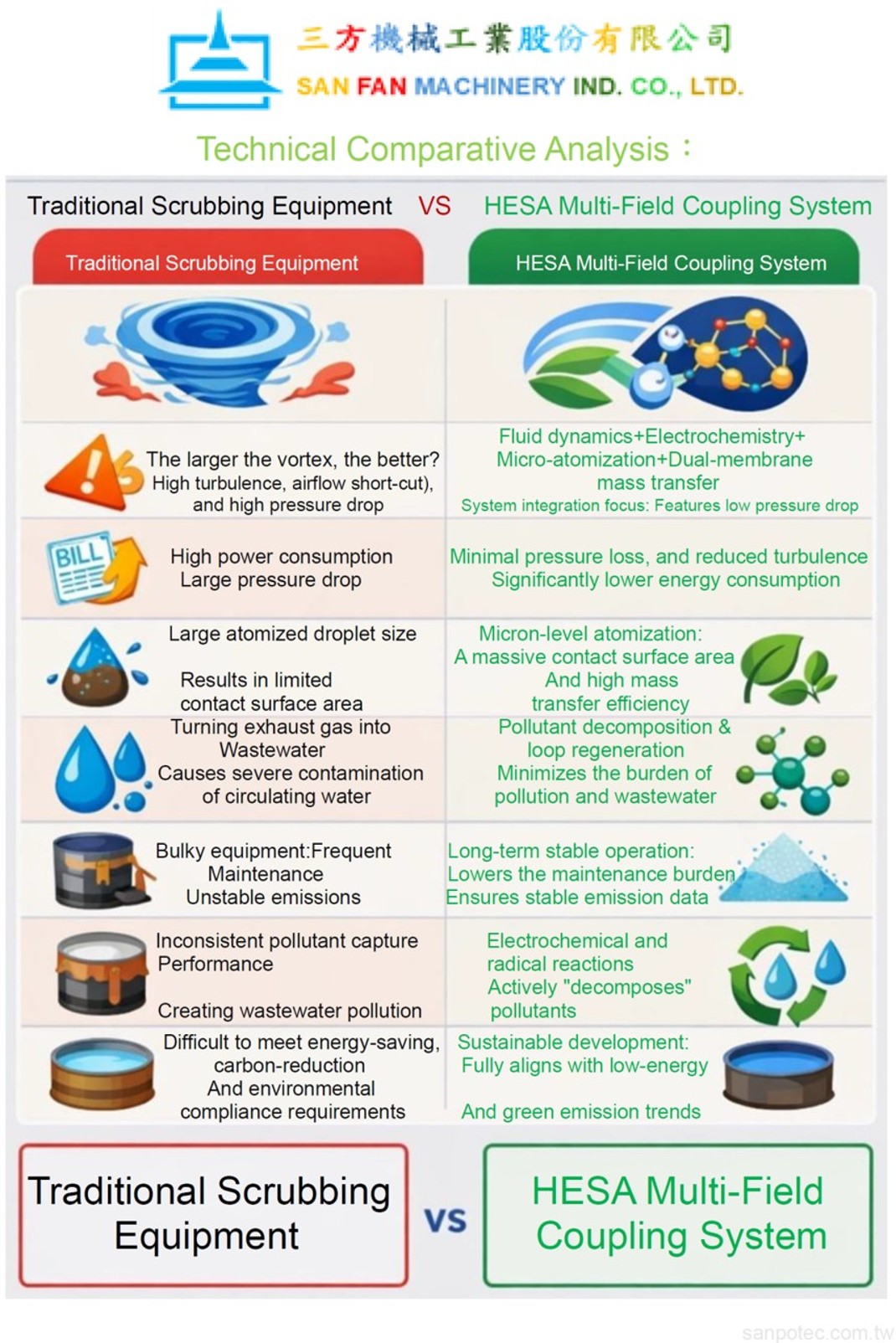
Conclusion: The Industry Must Move Beyond Vortex Obsession and Toward Real Technological Evolution
While the market continues competing over vortex size, the truly important question remains:
“Are pollutants actually being effectively treated?”
If a system only delivers:
• High energy consumption;
• High pressure loss;
• High maintenance requirements;
• High wastewater burden;
then even the largest vortex may simply represent another form of energy waste.
What industrial air pollution control truly needs is not stronger visual turbulence, but rather:
• More precise fluid control;
• More efficient mass transfer design;
• Deeper pollutant degradation;
• More comprehensive systems engineering.
Perhaps this is the core question HESA attempts to address:
Will the future of industrial environmental protection continue down the path of technological homogenization — or move toward genuine innovation and evolution?