
↓Solar Panel Rotating Mechanism
Light Energy Revolution: How Solar Tracking Systems Reshape the Energy Future
Energy Awakening Under the Shadow of Fukushima
On March 11, 2011, at 14:46 Japan Local Time, a magnitude 9.0 mega-earthquake occurred in the Pacific Ocean off the Tohoku region of Japan, historically called the “Great East Japan Earthquake.” The hypocenter depth of this earthquake reached 24 kilometers, it was the largest scale earthquake recorded in Japan, it triggered a tsunami up to 13 meters high, seawater rushed into the land like a beast, wherever it went houses were washed away, roads were submerged, a large number of people lost their homes and relatives, coastal cities and facilities were severely damaged, it caused 19,759 deaths, 2,553 missing, 6,242 injured, the economic loss reached as high as 16.9 trillion yen.
And more seriously, the tsunami struck the Fukushima Daiichi Nuclear Power Plant, causing the nuclear power plant’s cooling system to fail, the reactor cores to melt down, a large amount of radioactive material to leak, this is the world-shocking Fukushima nuclear accident. This accident was rated as the most severe Level 7 accident on the International Nuclear Event Scale, equivalent to the Chernobyl nuclear power plant accident, it had a profound impact on Japan’s and even the global energy structure.
After the Fukushima nuclear accident, nuclear power plants across Japan stopped operation one after another, to compensate for the shortage of electricity, fuel imports for thermal power generation increased substantially. International Energy Agency (IEA) investigation shows, Japan’s energy self-sufficiency rate in that year decreased by 6 percentage points year-on-year, fell to 13%, this is the lowest level in 30 years since 1981. For a long time, Japan’s energy self-sufficiency rate has been at a low level, over 90% of energy relies on imported fossil fuels. And this event made Japan’s energy supply fall into predicament, not only brought huge economic risk, but also made the greenhouse gas emission problem more serious, the crisis of resource depletion also increasingly approached.
Under this background, solar power generation, as a clean, renewable distributed energy source, gradually entered people’s field of vision, from the former “alternative option,” gradually moved towards the “main energy” stage. However, ordinary household or urban building roof area is limited, how to maximize power generation efficiency in limited space, became a difficult problem placed in front of people. Just at this time, “solar tracking system” emerged as the times require, it is like a ray of dawn in the darkness, brought new hope for solving the energy problem.
Limitations of Traditional Solar Panels
On sunny days, traditional solar panels are neatly arranged on roofs or vast ground, they are like silent guards, They remained steadfast in their posts. These solar panels are usually fixed facing south, at noon, sunlight almost vertically Sprinkle it on them, at this time they It was as if it had been injected with powerful energy. power generation efficiency reaches the peak of the day. Each solar panel Absorbing the sunlight to its heart’s content, converting it into electrical energy, providing clean energy for people’s life and production.
However, when the first morning light gently Touching the earth, or the evening sunsetDyed into a golden yellow the sky, the performance of traditional solar panels is unsatisfactory. Because they are fixed and cannot move, unable to adjust the angle according to the sun’s movement, sunlight can only irradiate them at a slanted angle. This is like when a person is receiving water, the bucket is not directly facing the faucet, causing most of the water to spill outside. At this time, the solar energy that solar panels can absorb decreases substantially, power generation efficiency also It then dropped sharply. Originally at noon they could work efficiently, but now But it seemed to have lost its vitality. can only We watched helplessly as precious sunlight was wasted.
In different seasons, traditional solar panels also face the same Dilemma. Summer, the sun’s position is higher, sunlight is stronger, but because solar panels cannot adjust the angle according to seasonal changes, in the morning and evening, still cannot fully utilize sunlight. And in winter, the sun’s position becomes lower, the sunlight irradiation angle becomes more slanted, the power generation efficiency of traditional solar panels is even more seriously affected. Even on sunny days, they It is also difficult to play its due role. let alone under overcast or cloudy weather conditions.
Traditional solar panels are like a stubborn craftsman, only knows how to work according to a fixed mode, unable to flexibly respond to external changes. Facing these problems, people started to think: how can we make solar panels break through the destiny of “depending on weather for food,” actively capture every precious ray of sunlight? This problem is like a key, opened people’s exploration journey of solar tracking systems.
Technological Evolution of Tracking Systems
(I) Dilemma of Mechanical Tracking
To solve the problem of low power generation efficiency of traditional solar panels, early engineers proposed “solar trajectory tracking” technology. This technology is like equipping solar panels with a knowledgeable astronomer, it through precise calculation, accurately masters the sun’s movement trajectory in the sky. Then, like a programmed clock, drives the solar panels to rotate according to the set trajectory.
Under clear and stable weather conditions, this method indeed showed certain advantages. It could make solar panels more accurately face the sun, thus improving solar energy absorption efficiency. In some large solar power stations, rows of solar panels are neatly arranged, they according to the solar trajectory tracking system’s commands, rotate orderly, It was as if a solemn ceremony was being performed, trying to capture every ray of sunlight. However, this technology also has obvious limitations, it is like a scholar who sticks to old rules, lacks flexibility to deal with emergencies. Once suddenly changing clouds appear in the sky, sunlight intensity and direction instantly change, the solar trajectory tracking system falls into Dilemma becomes was at a loss. Because it can only operate according to preset programs, unable to timely respond to this sudden change. It is like a person walking according to a set route, suddenly encounters the situation of the road ahead being blocked, but does not know how to change the route. In this situation, solar panels cannot adjust the angle according to actual light conditions, causing power generation efficiency to drop substantially, the original advantage instantly disappears.
(II) Breakthrough of Extremum Seeking Control
Just when people were troubled by the limitations of solar trajectory tracking technology, Sanpoh Mechanical Industries Co., Ltd. proposed a groundbreaking idea — “Extremum Seeking Control.” This innovative algorithm is like giving solar panels an intelligent brain, enabling them to have the ability to autonomously find the best power generation angle.
To better understand the principle of this algorithm, we can imagine such a scene: you are blindfolded, placed on a rolling hillside. Your task is to find the highest point of this hill. In the darkness, you cannot see the surrounding environment, nor do you know where the highest point is. But, you do not feel lost or helpless because of this. You start carefully Probe around, front, back, left, and right. every step you take, you carefully Feel the slope beneath your feet. If the upward feeling is more obvious, you firmly take a step in that direction. Like this, you continuously try, continuously adjust your direction. Although every step is full of unknowns and challenges, you never give up. After a period of effort, you finally stand on the hilltop, feel the joy of success.
The “Extremum Seeking Control” algorithm is like this process of finding the hilltop. It enables solar panels to have similar “touch,” able to autonomously perceive changes in the surrounding environment, and make corresponding adjustments. Specifically, the control algorithm commands the solar panels to perform regular, tiny oscillations (α cos (ωk)) near the current angle. Like every small tentative step you take on the hillside, these tiny oscillations of the solar panels, although the amplitude is small, are crucial. During the oscillation process, the system Real-time reading of power generation (P (k)) changes. This is like you feeling the changes in the slope underfoot, the change in power generation is the basis for the solar panel to judge the direction. Then, through processing like a high-pass filter, the system can accurately judge which oscillation direction can increase the power generation. Like you deciding the next step’s direction based on the slope change, the solar panel will steadily adjust the angle towards this direction that can increase power generation.
Through this method, solar panels no longer rely on preset astronomical algorithms, they themselves become a tireless “seeker of light.” No matter how the weather suddenly changes, whether a sunny day is suddenly blocked by clouds, or the sun’s position changes due to seasonal changes, it can rely on its own wisdom and perception ability, autonomously find the current best angle. In cloudy weather, when clouds move fast, sunlight appears and disappears, the Extremum Seeking Control algorithm can make solar panels quickly respond, timely adjust the angle, to maximize the use of limited sunlight. Compared with traditional solar trajectory tracking technology, its advantage is more obvious, able to maintain high power generation efficiency in complex and changing environments, brought new hope and breakthrough for solar power generation.
Experimental Verification of Excellent Performance
(I) Experimental Setup
To comprehensively, objectively evaluate the performance of different solar power generation modes, the research team carefully planned a unique experiment. They set up three solar power generation devices with different working modes in an open area with good light conditions, like three different style contestants, preparing to compete in this “power generation competition.”
First is the fixed solar panel, it is like a guardian adhering to tradition, fixed facing south 73 degrees angle, no matter how the sun moves, it always maintains this fixed posture, It was as if they were stubbornly guarding their own territory. This traditional installation method was widely used in the past, is the most familiar solar power generation mode to people.
The trajectory tracking solar panel is like a knowledgeable astronomy expert. It strictly follows the precisely calculated solar trajectory, through complex mechanical devices and preset programs, can accurately adjust the angle according to the sun’s movement in the sky. Before the experiment started, technicians needed to collect a large amount of astronomical data, including local longitude and latitude, time, season and other information, then use complex algorithms to calculate the sun’s position at different times, set precise operating trajectory for the trajectory tracking solar panel. During the experiment, it is like pulled by an invisible string, always closely follows the sun’s footsteps.
And the Extremum Seeking solar panel is an intelligent light seeker full of wisdom. It relies on the advanced “Extremum Seeking Control” algorithm, can autonomously find the best angle. In the experimental site, it stands quietly, the surface seems calm, but the interior contains powerful computing and perception capabilities. The control algorithm commands it to perform regular, tiny oscillations near the current angle, like a dancer gently swaying, simultaneously Real-time reading of power generation changes. Through analysis and processing of these data, it can quickly judge which oscillation direction can increase power generation, then steadily adjust the angle towards that direction.
The research team to ensure the accuracy and reliability of the experimental results, conducted strict parameter setting and debugging for all three modes of solar panels. They used solar panels of the same specifications, to ensure consistency in hardware conditions. At the same time, the environmental conditions of the experimental site were strictly controlled, ensuring all three modes were under the same light, temperature, humidity and other environmental factors. The data acquisition system was carefully deployed, able to record key data such as power generation and power generation power of each mode at different times in real-time and accurately, provided a solid foundation for subsequent analysis and comparison.
(II) Sunny Day Performance
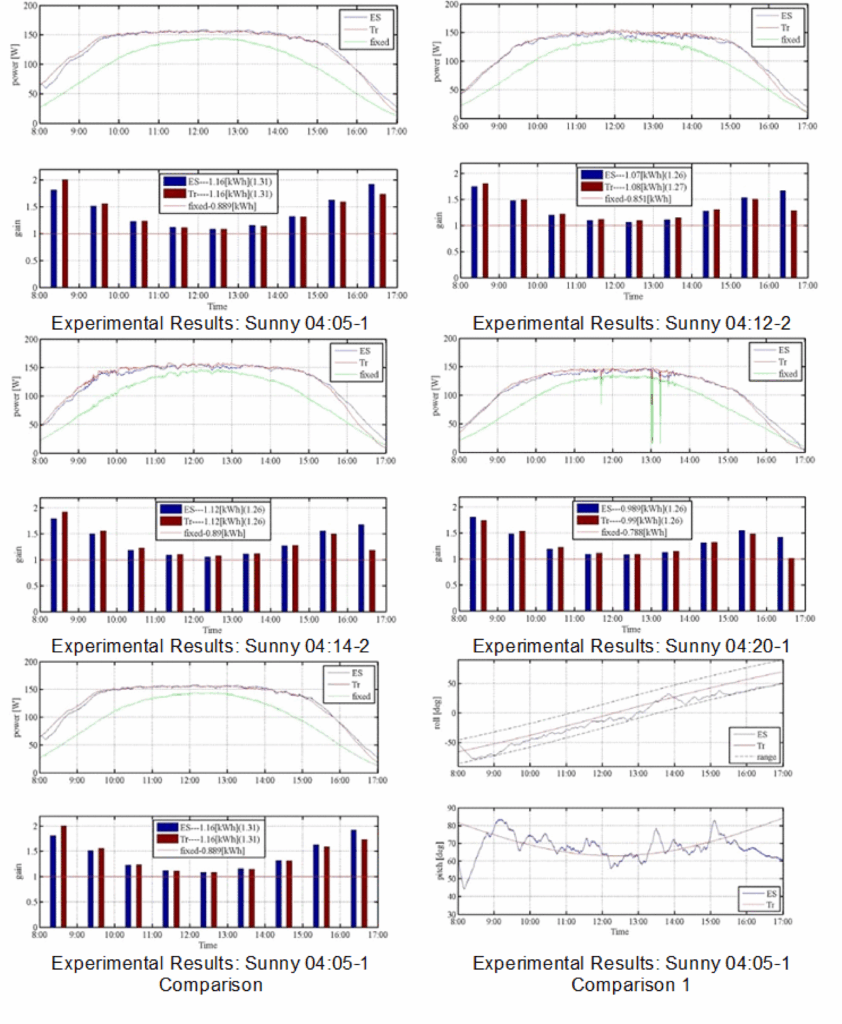
On a sunny day, the experiment officially started. The sky was blue like a gem, sunlight Sprinkled on the earth without reservation, provided a perfect stage for this “power generation competition.” The three modes of solar panels were all operating at full capacity, It was as if a fierce race was taking place.
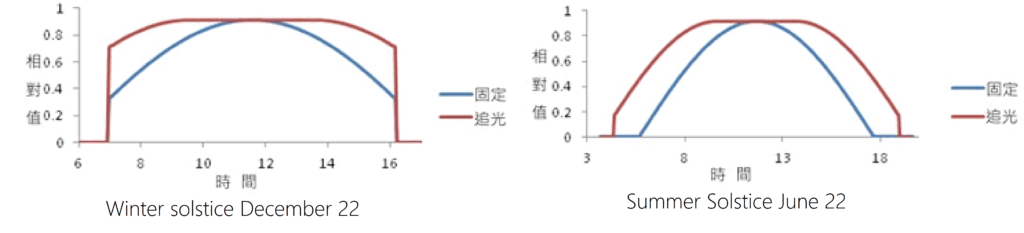
The fixed solar panel although Staying true to one’s position but in the early morning and evening, because of oblique sunlight, the solar energy it could absorb significantly decreased, power generation efficiency It also decreases accordingly. Although at noon, it could use vertically incident sunlight to achieve higher power generation efficiency, but overall, its power generation was at a disadvantage among the three modes.
The trajectory tracking solar panel fully utilized its advantage, strictly followed the preset solar trajectory. Throughout the daytime, it could all relatively accurately face the sun, absorb sufficient solar energy. Whether early morning when the sun just rose, or evening when the sun gradually set, it could all timely adjust the angle, maintain efficient capture of sunlight. Under clear weather conditions, its power generation performance was excellent, had a significant improvement compared to the fixed solar panel.
And the Extremum Seeking solar panel’s performance was equally amazing. It relied on the unique algorithm, in continuous self-adjustment and exploration, found the best power generation angle. In this day’s experiment, its performance was on par with the trajectory tracking solar panel, power generation was 25%-31% higher than the fixed type. This data proved, under ideal sunny conditions, the intelligent algorithm could achieve or even exceed the precision level of astronomical calculation. The Extremum Seeking solar panel is like a flexible athlete, able to timely adjust its strategy according to the actual situation, always maintain an efficient power generation state. Its success, not only demonstrated the Great potential of intelligent algorithms, but also brought new ideas and directions for the development of solar power generation technology.
(III) Cloudy Weather Advantage
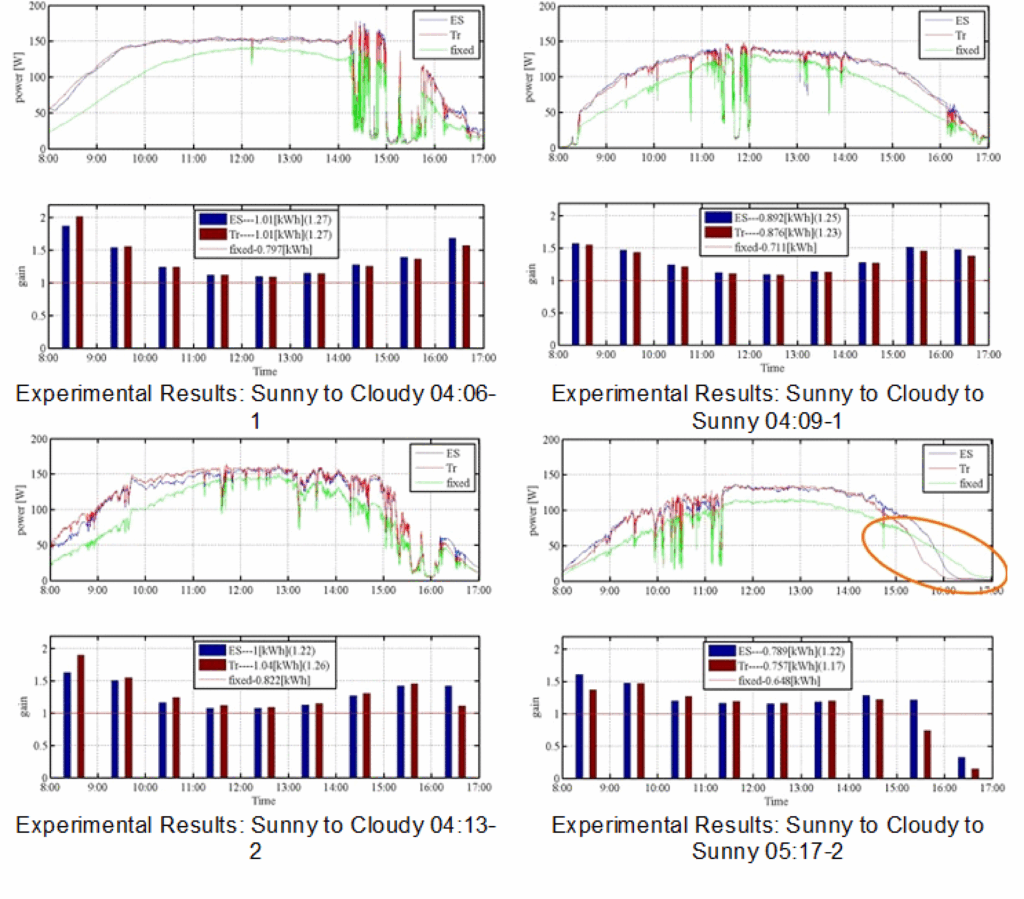
When cloudy weather appears in the sky, the situation changes somewhat. Clouds are like a group of mischievous children, continuously Shuttle, move in the sky, sometimes blocking sunlight, sometimes letting sunlight through, making light intensity and direction become complex and changeable.
In this situation, the limitations of the trajectory tracking solar panel begin to appear. Because it relies on the preset solar trajectory, when clouds suddenly block sunlight, causing the actual light situation to not match the preset trajectory, it becomes difficult to quickly adjust. Like a driver following a set route, suddenly encounters the road ahead temporarily blocked, but does not know how to change the route, the trajectory tracking solar panel when facing cloud interference, seems somewhat Helpless power generation efficiency is relatively greatly affected.
However, the Extremum Seeking solar panel showed Strong adaptability. Its “Extremum Seeking Control” algorithm is like equipping it with sharp eyes and a flexible brain, able to Real-time sensing of light intensity changes, and quickly respond. When clouds block sunlight, it through tiny oscillations and real-time monitoring of power generation power, quickly judges the direction and intensity changes of sunlight, then timely adjusts the angle, to maximize the use of limited sunlight. In the weather change process from cloudy to clear or clear to cloudy, it can adapt to light intensity changes faster than mechanical trajectory tracking, tightly “bites” the maximum power point, power generation efficiency improved by 22%-27%. The Extremum Seeking solar panel is like an experienced hunter, in a complex environment can quickly capture the target, always maintain efficient power generation efficiency. Its excellent performance under cloudy weather further proved the Huge advantage of intelligent algorithms in dealing with complex light conditions, provided strong guarantee for the stable operation of solar power generation under various weather conditions.
(IV) Rainy or Overcast Day Situation
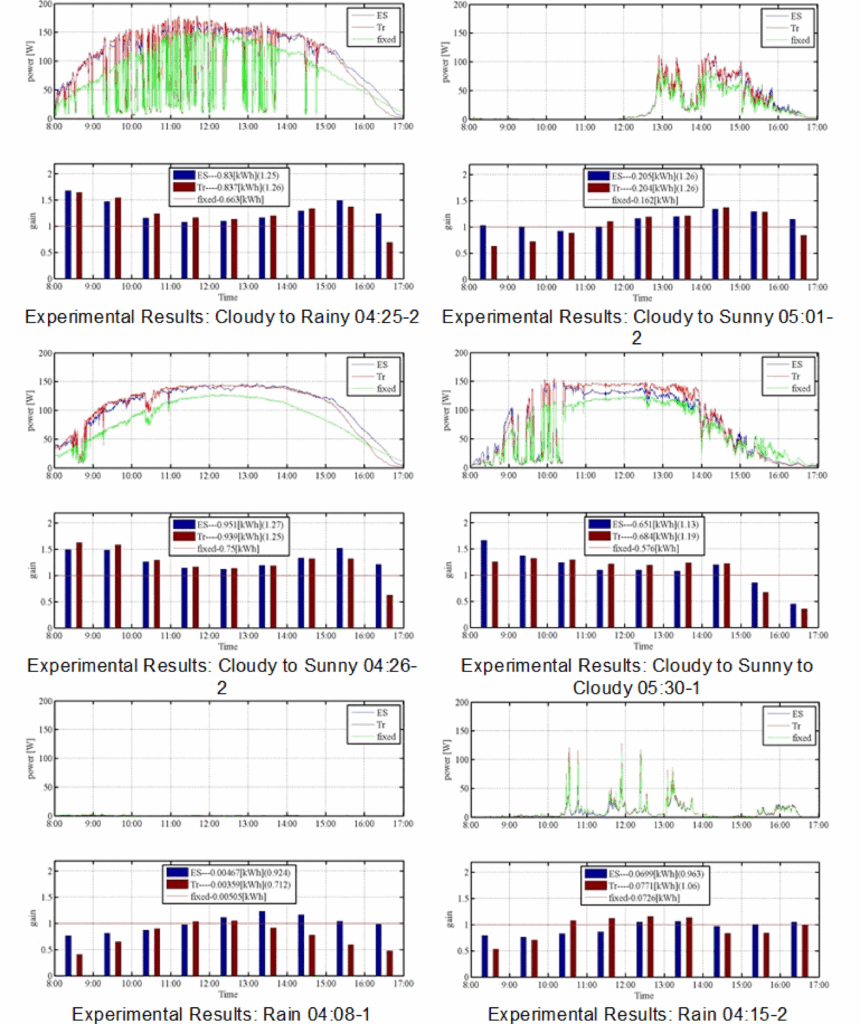
When the sky is completely covered by thick clouds, ushering in rainy or overcast days, the whole world becomes dark. Under such weather conditions, sunlight becomes very weak, almost unable to provide sufficient energy for solar panels.
For fixed and trajectory tracking solar panels, such weather is undoubtedly a severe test. Due to lack of sufficient direct sunlight, their power generation efficiency drops sharply, almost unable to work normally. Like machines that lost power, they appear powerless under weak light, power generation is negligible.
And the Extremum Seeking solar panel although also affected by the weather, its intelligent algorithm made it make wiser decisions in this situation. The system through real-time monitoring of light intensity and power generation power, judges that the current light conditions are insufficient to support normal power generation. So, it automatically enters low-power sleep mode, like animals entering hibernation in winter, reduces its own energy consumption, to save power. In this mode, the solar panel stops unnecessary operation, only maintains the minimum system operation, thus effectively reducing energy loss. This energy-saving strategy not only reflects the intelligence of the Extremum Seeking solar panel, but also provides guarantee for its long-term stable operation under harsh weather conditions. When the weather turns clear, sunlight shines on the earth again, it can quickly wake up from sleep mode, resume normal power generation work, continue to provide clean energy for people.
In-depth Analysis of Working Principles
(I) Photovoltaic Effect
After understanding the excellent performance of the solar tracking system, let us deeply explore the core principle behind it, starting from the photovoltaic effect. The photovoltaic effect is the foundation of solar power generation, it is like a wonderful dance in the micro world, photons and semiconductor materials interact on this stage, together perform the wonderful chapter of electric energy birth.
When sunlight, this energy flood composed of countless photons, irradiates the semiconductor material, wonderful things happen. Semiconductor material, like common silicon, internally exists two important carriers: negatively charged electrons and positively charged holes. Can imagine them as a pair of intimate partners, usually under the Restraint of atoms, living a relatively stable life. However, when the photon’s energy is strong enough, greater than the semiconductor material’s band gap width, it is like a brave messenger, broke this calm. Photon strikes the semiconductor atom, “knocks” the electron out of the atom’s Restraint makes it a free electron, simultaneously leaves a hole in the original position. Thus, one photon successfully produces a pair of freely moving carriers: electron-hole pair. This is like throwing a stone into a calm lake, It stirred up ripples.
Simply producing electron-hole pairs is not enough to generate current, they easily recombine and disappear. At this time, the PN junction comes on stage, it is the key structure of the photovoltaic cell. The PN junction is formed by a piece of semiconductor material through doping process, one side forms electron-rich N-type semiconductor, the other side forms hole-rich P-type semiconductor, at their junction the PN junction is formed. Inside the PN junction exists a built-in electric field pointing from the N region to the P region, this electric field is like a strict commander, responsible for guiding the movement of electrons and holes. When the photogenerated electron-hole pair is generated near the PN junction, under the action of the built-in electric field, free electrons will be pushed to the N-type region by the electric field force, holes will be pushed to the P-type region by the electric field force. Like this, the photogenerated positive and negative charges are effectively separated, Gathered at both ends of the battery respectively, electrons in the N region, holes in the P region. The charge separation generates a potential difference on both sides of the PN junction, that is, voltage. At this time, if connecting an external load, like a light bulb, motor, etc., between the photovoltaic cell’s P-type region (anode) and N-type region (cathode) with a wire, constitutes a circuit. Because there is voltage between the P region and N region, free electrons have the motivation to flow from the N region to the P region through the external circuit, current is formed. As long as the light irradiation continues, this process of generating charge, separating charge, forming current, electron backflow will continue, thus continuously outputting direct current. The photovoltaic effect is like a magical key given to us by nature, opened the door to using solar energy for power generation.
(II) I-V Characteristics and Maximum Power Point Tracking
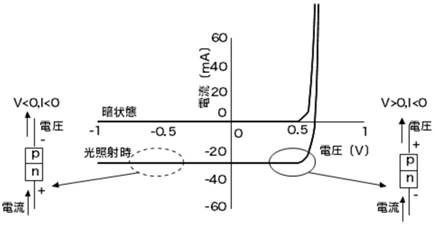
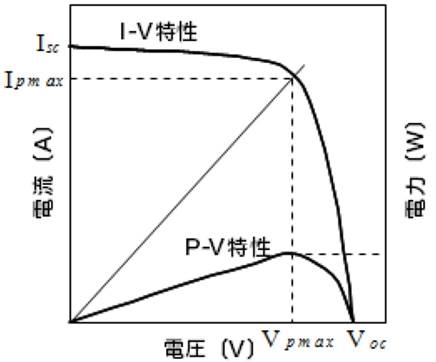
The output characteristics of solar panels are like a mysterious treasure, containing rich information, and the I-V characteristic curve is the key to opening this treasure. The I-V characteristic curve, That is, the current-voltage characteristic curve.comprehensively reflects the electrical performance of solar panels under different light and temperature conditions. Under ideal conditions, when solar panels receive stable light irradiation, their output current and voltage show a unique nonlinear relationship. On this curve, we can find several key parameters, open-circuit voltage (Voc), it is like the “potential value” of the solar panel, representing the highest voltage that the solar panel can reach when no external load is connected; short-circuit current (Isc) is like the “burst force” of the solar panel, representing the maximum current that the solar panel can output in a short-circuit state; and the maximum power point voltage (Vmp) and maximum power point current (Imp), are what we care about most, they together determine the maximum power that the solar panel can output under current conditions. At the maximum power point, the efficiency of the solar panel converting light energy into electrical energy reaches the highest, like an athlete performing at their best state They performed to their absolute limit.
However, the working environment of solar panels is complex and changeable, factors like light intensity, temperature are constantly changing, this causes the maximum power point to also change accordingly. To keep the solar panel always in the best working state, output power to the maximum extent, we introduced Maximum Power Point Tracking (MPPT) technology. The MPPT circuit is like an intelligent housekeeper of the solar panel, it always pays attention to the output state of the solar panel, through real-time monitoring of current and voltage changes, continuously adjusts circuit parameters, This ensures that the solar panels always operate near their maximum power point. Its working principle is based on a simple yet profound physical principle, for linear circuits, when the load resistance equals the internal resistance of the power source, the power source can output maximum power. Although solar cells and DC-DC conversion circuits are both strongly nonlinear, in a very short time, they can be approximated as linear circuits. Therefore, the MPPT circuit by adjusting the equivalent resistance of the DC-DC conversion circuit, makes it always equal to the internal resistance of the photovoltaic cell, thus The maximum power output of the photovoltaic cells was achieved. In practical applications, the MPPT circuit usually uses Multiple advanced algorithms to achieve this goal, such as constant voltage tracking method, perturbation and observation method, incremental conductance method, etc. These algorithms Each has its own characteristics. but their common goal is to make the solar panel always maintain an efficient power generation state in a complex environment, fully utilize every ray of sunlight, provide us with more clean energy.
(III) Conversion Efficiency and Temperature Impact
The conversion efficiency of solar panels is an important indicator to measure their performance, it is like a ruler, measuring the ability of solar panels to convert solar energy into electrical energy. However, this conversion efficiency is not constant, it is affected by Multiple factors, among which temperature is a key factor that cannot be ignored.
Under ideal temperature conditions, usually 25°C, solar panels can fully perform their performance, achieve the highest power generation efficiency. At this temperature, various physical processes inside the solar panel are in a state of balance and coordination, the movement of electrons and holes is also the smoothest, enabling the solar panel to efficiently convert light energy into electrical energy. However, when the temperature rises, the situation changes. As the temperature rises, the power generation efficiency of solar panels gradually decreases. This is because high temperature triggers a series of physical and chemical processes that are unfavorable for power generation. First, high temperature increases the carrier recombination rate in the solar panel, causing more light energy to be consumed before being converted into electrical energy, converted into thermal energy, like a originally smooth relay race, because of baton handover errors wasted a lot of time. In addition, high temperature also increases the conductive loss in the solar panel, making electrons and holes more likely to recombine again, thus reducing the photocurrent and open-circuit voltage. It is like a originally smooth road, because many obstacles appear, causing vehicles to slow down, or even unable to pass. Excessive temperature can also cause failure and degradation of materials in the solar panel, for example, temperature increase This will reduce the band gap of semiconductor materials. further reducing the ability to absorb light, like a person’s vision decreases, unable to see surrounding things. Thermal expansion and thermal stress can also cause structural damage and damage to materials in the solar panel, further reducing its performance. To cope with the impact of temperature on solar panel efficiency, scientists and engineers have come up with many methods. One common method is to dissipate heat around the solar panel, by installing heat sinks, fans and other equipment, increase air circulation, timely dissipate the heat generated by the solar panel, thus Lower its temperature, improve work efficiency. Like we use fans to cool down in hot summer. Using temperature compensation technology is also an effective means, through circuit design and algorithm adjustment, offset the impact of temperature changes on solar panel performance, maintain its performance stability. Like putting a pair of smart glasses on the solar panel, able to automatically adjust vision, adapt to different environments. In practical applications, we need to comprehensively consider various factors, take appropriate measures to reduce the impact of temperature on solar panel conversion efficiency, let solar panels under different temperature conditions To maximize performance provide us with more clean, sustainable energy.
Practical Application Case Analysis
(I) Experimental Setup
On the roof of a certain university, an experiment about solar power generation is quietly unfolding. Here, like a special laboratory, witnessing the magical journey of the solar tracking system. Researchers carefully set up two sets of solar panels of the same specifications, they are like two contestants with comparable strength, preparing to compete in this “power generation competition.”
One set is the tracking solar panel, it is equipped with an advanced ECO-WORTHY tracker, like installing A pair of bright eyes and A pair of flexible arms on it, able to automatically adjust the angle according to the sun’s position. In the east-west direction, it can freely rotate, always maintaining the pursuit of the sun. When the first morning light Sprinkled on the roof, the tracker starts working, it Keenly sensing the direction of the sunlight, then quickly commands the solar panel to rotate, meet the sunlight at the best angle. Whether the sun moves slowly in the sky, or clouds occasionally block sunlight, the tracking solar panel can timely respond, always closely follow the sun’s footsteps.
The other set is the fixed solar panel, it is fixed at a 20-degree tilt angle facing south, like a guardian adhering to tradition, always maintaining this fixed posture, no matter how the sun changes, it remains unmoved. Before the experiment started, researchers carefully measured and adjusted its angle, ensured it was in a relatively stable state. However, when facing the sun’s movement and weather changes, its limitations It is gradually becoming apparent.
To accurately record experimental data, researchers used a simulated MPPT load and data acquisition system. This data acquisition system is like a diligent recorder, it can Real-time monitoring and recording of solar panel power generation data. Whether power generation, power generation power, or light intensity, temperature and other environmental factors, it can record them one by one. At regular intervals, it transmits these data to a computer, for researchers to analyze and compare. Throughout the experiment, the data acquisition system always maintained high accuracy and stability, provided strong guarantee for the success of the experiment.
(II) Cloudy Day Results
On October 15, 2015, this was a cloudy day. In the sky, clouds are like a group of mischievous children, playing between the sun and the earth, sometimes blocking sunlight, sometimes letting sunlight through, making light intensity and direction become complex and changeable. Under such weather conditions, both the tracking solar panel and the fixed solar panel are working hard.
The tracking solar panel relying on its tracker, continuously adjusts the angle, trying to capture every ray of sunlight. It is like a flexible dancer, looking for the direction of sunlight in the gaps of clouds. However, because scattered light dominates, sunlight becomes dispersed and unstable, the advantage of the tracking solar panel is not fully utilized. Finally, its power generation is 750.11Wh.
The fixed solar panel still Staying true to one’s position, unable to adjust the angle according to light changes. In such cloudy weather, the light it receives is more uneven, power generation efficiency is also relatively greatly affected. Finally, its power generation is 660.72Wh.
Through calculation, the power generation of the tracking solar panel is 14% higher than that of the fixed solar panel. Although this increase rate is relatively limited under cloudy weather, the tracking solar panel still They are striving to play their role and maximize power generation. This also indicates, in cloudy weather where scattered light is dominant, the solar tracking system although can improve power generation efficiency to a certain extent, but due to light condition limitations, its advantage is not as obvious as in clear weather.
(III) Sunny Day Results
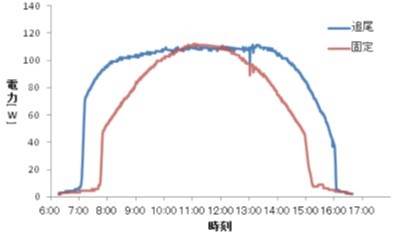
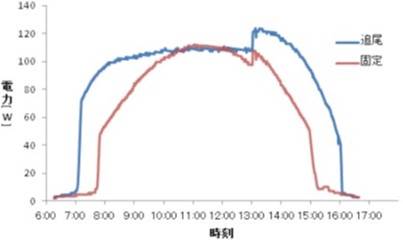
On November 4, 2015, the sun was Bright, the sky was blue like a gem, without a trace of cloud Obstruction, this was a sunny day very suitable for solar power generation. In such good weather, the tracking solar panel and the fixed solar panel competed again.
The tracking solar panel under the control of the tracker, performed exceptionally well. From early morning when the sun just rose, it started chasing sunlight, as the sun moved in the sky, it continuously adjusted the angle, always maintaining perpendicular to the sunlight. In the morning and afternoon, the sun’s angle gradually changed, the tracking solar panel could all timely respond, efficiently absorb solar energy. Throughout the daytime, it was like a tireless energy collector, fully utilizing its advantages. Finally, its power generation reached 882.61Wh.
The fixed solar panel because it is fixed installed, in the early morning and evening, sunlight is oblique, the solar energy it can absorb significantly decreases, power generation efficiency It also decreased accordingly. Only at noon, when sunlight is almost Vertical illumination, it can achieve higher power generation efficiency. But from the Total daily power generation view, its performance is obviously inferior to the tracking solar panel. Finally, its power generation is 663.32Wh.
The power generation of the tracking solar panel is 33% higher than that of the fixed solar panel, this data fully proves the significant advantage of the tracking system under clear weather. In the morning and evening periods, when the sun’s angle changes, the tracking system can make the solar panel always face the sun, maximize the capture of sunlight, thus significantly increasing power generation. In this sunny day experiment, the tracking solar panel is like a champion contestant, in the competition with the fixed solar panel, showed strong strength and excellent performance.
(IV) Tracking System Power Consumption
The tracking system during operation, itself also consumes a certain amount of energy. Its standby power consumption is about 2.5W/h, like a small light bulb, continuously consuming electrical energy in standby state. And the total daily power consumption is about 25.56Wh, this value although seems not large, but for power generation efficiency evaluation, is a factor that cannot be ignored.
After calculation, the total daily power consumption of the tracking system only accounts for 3% of the day’s power generation. This proportion is relatively low, indicating that the tracking system while improving power generation, its own energy consumption is well controlled. Although it needs to consume a certain amount of electrical energy to drive the tracker, achieve the angle adjustment of the solar panel, but compared to the power generation gain it brings, these consumptions are negligible. It is like a car, although it needs to consume a certain amount of fuel during driving, it can quickly send people to the destination, the convenience brought far exceeds the fuel consumption. The tracking system is the same, it by consuming a small amount of electrical energy, realizes the efficient capture of sunlight by the solar panel, greatly improves power generation, provides more reliable guarantee for the practical application of solar power generation.
Theoretical Model Construction and Prediction
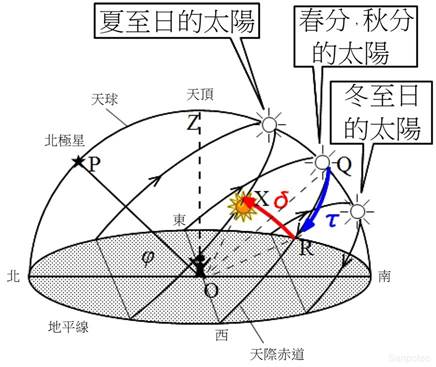
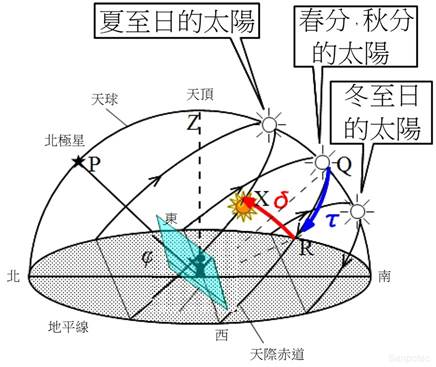
To deeper understanding the performance of the solar tracking system, and accurately predict its future application, the research team established a set of mathematical models based on the hour angle-declination coordinate system. This model is like a precise key, able to open the mystery door of solar power generation, reveal the sun’s movement trajectory in a year, and the power generation situation of the tracking system and fixed system under different conditions.
In this mathematical model, two key formulas play a core role. First is the solar elevation angle calculation formula: h=sin-1(sinφsinδ+cosφcosδcosτ). In this formula, each parameter contains specific physical meaning. represents the solar elevation angle, it is an important indicator to measure the sun’s position height in the sky, like a ruler, measuring the angle between the sun and the horizon.
represents the local geographical latitude, it determines the observation location on the earth, different latitudes cause the solar elevation angle to change differently during the day.
is the solar declination, it reflects the sun’s position on the celestial sphere relative to the equator, changes with the seasons, is one of the important factors affecting the solar elevation angle.
is the hour angle, it represents the angular difference of the sun relative to the local noon time, changes continuously over time, reflects the sun’s movement trajectory during the day. Through this formula, we can accurately calculate the solar elevation angle at different times and locations, provides important basic data for subsequent research.
Another key formula is the tracking/fixed ratio calculation formula: Wd/Ws=(α+sin(β-α))/sinβ. In this formula, represents the power generation of the tracking system, it is the total amount of solar energy converted into electrical energy by the tracking system in a certain time, reflects the power generation capability of the tracking system.
represents the power generation of the fixed system, is the total power generation of the fixed installed solar panel in the same time.
and
are parameters related to the sun’s position and solar panel angle, their values will vary according to specific situations, through analysis and calculation of these parameters, we can get the ratio of power generation between the tracking system and the fixed system, thus intuitively compare the power generation efficiency of the two.
Based on this mathematical model, the research team conducted a comprehensive and in-depth annual power generation prediction. They assumed the tracking range is set to ±37°, under this set condition, through complex and precise calculation, concluded that the annual average tracking/fixed ratio can reach 1.44. This means, in a year’s time, the power generation of the tracking system is on average 1.44 times that of the fixed system, fully demonstrates the Huge advantage of the tracking system in improving power generation efficiency.
The research team also considered the tracking system’s own power consumption problem. After deducting the system’s own power consumption, the net ratio still reaches 1.40. Although the tracking system needs to consume a certain amount of electrical energy to drive the motor and control system during operation, compared to the power generation gain it brings, these consumptions are relatively small. Even after deducting its own energy consumption, the tracking system can still maintain Higher electrical efficiency, provides strong guarantee for the efficient utilization of solar energy. The establishment of this theoretical model, not only provided an important tool for us to deeply understand the working principle and performance of the solar tracking system, but also laid a solid theoretical foundation for its large-scale application and promotion in the future. Through this model, we can more accurately predict the power generation situation of the tracking system under different environmental conditions, provide scientific basis for the planning, design and operation of solar power generation projects, help the development of the solar energy field to move towards a new stage.
Future Outlook
(I) Technological Evolution Direction
With the rapid development of technology, the technology of solar tracking systems is also constantly evolving. Looking back at its development history, from the initial simple fixed installation solar panels, to the later solar trajectory tracking technology, to the current advanced Extremum Seeking Control technology, every technological change brought significant improvement in power generation efficiency. In this long river of technological evolution, we can clearly see a trend: intelligence is the core direction of the future development of solar tracking systems.
Compared with the traditional fixed installation method, solar trajectory tracking technology is undoubtedly a major breakthrough. It through precise calculation of the sun’s operating trajectory, realized the automatic rotation of solar panels, enabled solar panels to better receive sunlight, thus improved power generation efficiency. In some large solar power stations, the application of solar trajectory tracking technology made power generation significantly increase, contributed to energy supply. However, this technology still has certain limitations, it cannot timely respond to emergencies like sudden weather changes, causing power generation efficiency to be affected to a certain extent in practical applications.
And the emergence of Extremum Seeking Control technology completely broke this Dilemma. It endowed solar panels with autonomous perception and decision-making capabilities, enabled them to automatically adjust the angle according to real-time light conditions, realized truly intelligent light tracking. In practical applications, Extremum Seeking Control technology showed Powerful advantages, whether in sunny or cloudy weather, it can make solar panels maintain high power generation efficiency. When facing sudden cloud Obstruction, it can quickly respond, adjust the angle of solar panels, maximize the use of limited sunlight, thus ensured the stability and high efficiency of power generation.
Intelligent solar tracking systems also have higher adaptability and flexibility. It can according to different geographical locations, seasonal changes and weather conditions, automatically adjust the tracking strategy, to achieve the best power generation effect. In high latitude regions, winter sun position is lower, light time is shorter, intelligent tracking systems can by adjusting the angle and operation mode, fully utilize limited sunlight, improve power generation efficiency. Intelligent tracking systems can also intelligently link with other energy systems, realize optimal configuration and efficient utilization of energy. It can combine with energy storage systems, store excess electricity when sunlight is sufficient, release it when light is insufficient, ensure stable energy supply.
From the perspective of technological evolution, intelligent solar tracking systems have advantages that traditional technologies cannot match, it represents the future development direction of solar power generation technology. With the continuous development of technologies such as artificial intelligence, big data, and the Internet of Things, the intelligence level of solar tracking systems will continuously improve, provide stronger support for global energy transition and sustainable development.
(II) Optimization Strategies
To further improve the performance and efficiency of solar tracking systems, we need to optimize from multiple aspects. In future development, weather adaptation, hardware upgrades, and algorithm refinement will become key strategies for optimizing solar tracking systems.
Weather adaptation is an important direction for optimizing solar tracking systems. In practical applications, solar tracking systems will face various complex and changeable weather conditions, such as sunny, cloudy, overcast, rainy, etc. To better adapt to these weather changes, solar tracking systems need to have intelligent weather adaptation capabilities. When encountering insufficient sunlight, the system can automatically detect changes in light intensity, and timely make judgments, automatically enter low-power sleep mode. In this mode, the system will turn off some unnecessary functions, reduce its own energy consumption, like animals reducing metabolism during hibernation, to save energy. When the weather turns clear, light intensity recovers to a certain extent, the system can quickly wake up from sleep mode, restore normal tracking and power generation functions, continue to provide users with clean energy. This intelligent weather adaptation function can not only improve the energy utilization efficiency of the solar tracking system, but also extend the system’s service life, reduce maintenance costs.
Hardware upgrade is also key to improving the performance of solar tracking systems. With the continuous progress of technology, new materials and technologies continue to emerge, providing broad space for hardware upgrades of solar tracking systems. In future development, we can adopt lower power consumption motors and transmission mechanisms, to reduce system energy consumption. New motor technology can achieve higher efficiency and lower energy consumption, optimized design of transmission mechanisms can reduce energy loss, improve the overall performance of the system. We can also adopt more efficient solar panels, to improve solar energy conversion efficiency. New solar panel materials and manufacturing processes are constantly improving, making the conversion efficiency of solar panels continuously improve, able to convert more solar energy into electrical energy. Through these hardware upgrade measures, solar tracking systems can while improving power generation efficiency, reduce their own energy consumption, achieve more efficient and environmentally friendly operation.
Algorithm refinement is one of the core strategies for optimizing solar tracking systems. The algorithm of the solar tracking system determines its tracking accuracy and efficiency. In future development, we need to continuously improve and optimize the algorithm, make the “light seeking” process faster and more accurate. With the continuous development of artificial intelligence and machine learning technologies, we can apply these advanced technologies to the algorithm of solar tracking systems. Through deep learning algorithms, the system can analyze and learn a large amount of light data and power generation data, thus more accurately predict the sun’s position and light intensity changes, achieve more precise tracking control. We can also adopt more intelligent optimization algorithms, such as genetic algorithms, particle swarm optimization algorithms, etc., to optimize the operating parameters of the solar tracking system, to achieve the best power generation effect. Through algorithm refinement, solar tracking systems can quickly and accurately find the best power generation angle in complex and changeable environments, improve power generation efficiency, provide users with more clean energy.
(III) Far-reaching Significance
The emergence and development of solar tracking systems is not just a technological innovation, but an important change that has a profound impact on the global energy structure and environmental protection. In today’s society, energy autonomy and environmental friendliness have become important goals for global development, and solar tracking systems are one of the key technologies to achieve these goals.
From the perspective of energy autonomy, solar tracking systems provide us with a more reliable and sustainable way to obtain energy. For a long time, many countries and regions have faced the problem of energy dependence on imports, which not only poses huge risks to national energy security, but also limits economic development to a certain extent. And solar energy, as an inexhaustible and clean energy source, is widely distributed and not restricted by region. Through solar tracking systems, we can more efficiently utilize solar energy, convert it into electrical energy, meet our daily life and production energy needs. This can not only reduce dependence on traditional fossil energy, lower energy import costs, but also improve the country’s energy self-sufficiency rate, enhance energy security. In some remote areas, solar tracking systems can provide independent power supply for local residents, solve long-standing power problems, promote local economic development and social progress.
In terms of environmental protection, solar tracking systems also play an important role. Traditional fossil energy releases a large amount of greenhouse gases, such as carbon dioxide, sulfur dioxide, etc., during the combustion process. These gases are one of the main causes of global climate change and environmental pollution. And solar tracking systems It produces almost no pollutants. during the power generation process, it is a truly clean energy. By large-scale application of solar tracking systems, we can reduce the use of fossil energy, thereby reducing greenhouse gas emissions, alleviating the pressure of global climate change. Solar tracking systems can also reduce the occupation of land resources, avoid the destruction and pollution of land during traditional energy mining. In some cities, solar tracking systems can be installed on building roofs, walls and other places, achieve effective utilization of urban space, and also add a green landscape to the city.
Today, as the world actively promotes carbon neutrality goals, the importance of solar tracking systems is More prominent. Carbon neutrality refers to achieving net-zero carbon dioxide emissions by reducing greenhouse gas emissions and increasing carbon sinks. Solar tracking systems, as a clean energy technology, can not only directly reduce carbon dioxide emissions, but also provide support for carbon emission reduction in other industries. In the industrial field, solar tracking systems can provide electricity for factories, reduce factories’ dependence on traditional energy, thereby reducing carbon emissions during industrial production. In the transportation field, solar tracking systems can charge electric vehicles, promote the popularity of electric vehicles, reduce carbon emissions during transportation. The development and application of solar tracking systems provide strong technical support for us to achieve carbon neutrality goals, and are an important guarantee for us to move towards a green and sustainable development path.
Solar tracking systems, with their excellent performance and broad application prospects, have become a shining star in the energy field. It not only solves the problem of low power generation efficiency of traditional solar panels, but also makes great contributions to energy autonomy and environmental protection. With the continuous progress and optimization of technology, we have reason to believe that solar tracking systems will play a more important role in the future energy stage, leading us to a more intelligent, efficient, and green new energy era.
<Back to previous page