
↓Solar Panel Rotating Mechanism
🌞 Solar Panel Supporting and Rotating Mechanism: Development and Technical Significance
— A New Supporting System Realizing High-Efficiency Energy Utilization through Solar Tracking —
1. Introduction
In recent years, with the progress of science and technology, human life has become more convenient and comfortable than ever before.
However, on the other hand, the depletion of Earth’s resources and the global warming caused by massive consumption of fossil fuels have become global issues.
In particular, climate change has already had a serious impact on human life and industrial activities, and the sustainable use of resources and reduction of environmental burdens has become urgent.
Under such a background, among renewable energies, solar energy is regarded as one of the most promising alternative energies because it possesses stable supply and high universality.
To efficiently convert solar energy into electricity, not only the performance of solar cell panels (solar panels) but also their installation structure and tracking mechanism become important factors.
2. Problems of Conventional Structure
Conventional solar panels are generally installed on a fixed supporting frame.
Although this method has the advantages of simple structure and easy installation, it possesses the following drawbacks:
- Since the angle of the panels is fixed, they cannot correspond to the positional changes of the sun.
- During periods such as morning, evening, or winter, when the incident angle of sunlight changes, power generation efficiency significantly decreases.
- During bad weather such as strong wind or heavy rain, the risk of panel damage is high.
- Application to water-surface or portable types is difficult, resulting in large restrictions on installation environments.
3. Concept of the New Supporting and Rotating Mechanism
In this research and development, we propose a solar panel supporting and rotating mechanism that realizes solar tracking while possessing structural stability and durability.
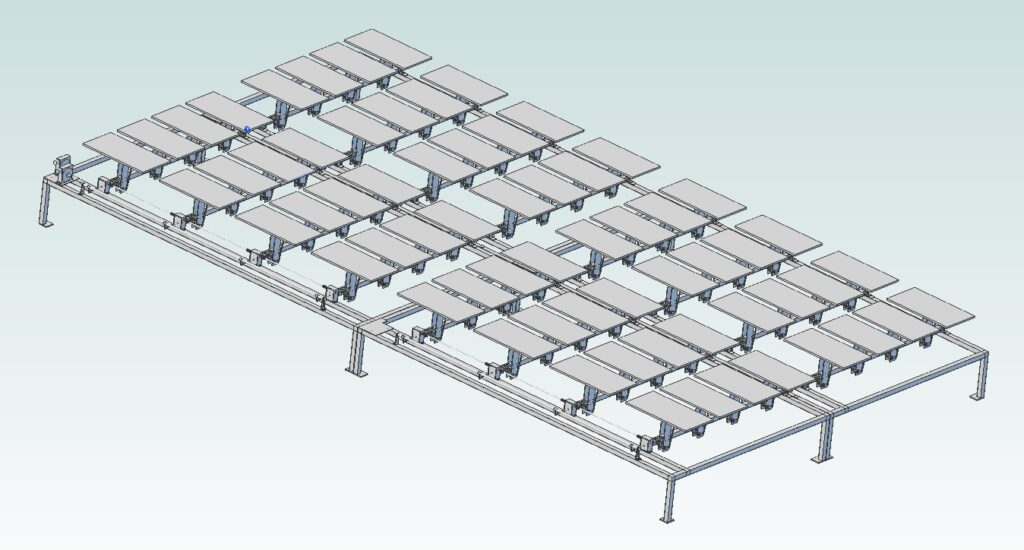
This mechanism arranges multiple solar panels in a matrix form and controls each panel in the X-axis (horizontal rotation) and Y-axis (forward and backward inclination) directions, aiming to constantly maintain the optimal light-receiving angle.
4. Structural Overview
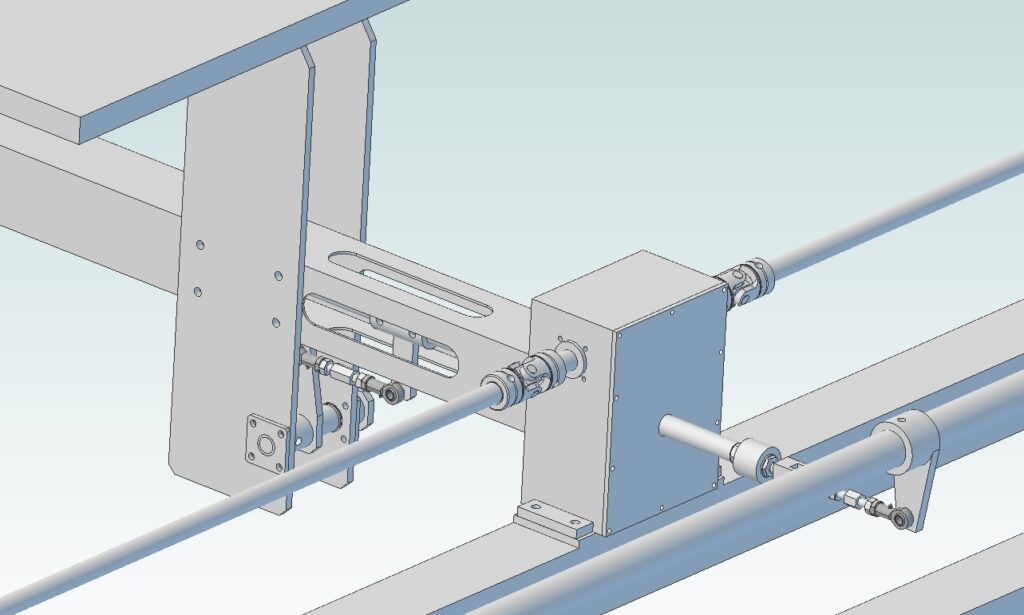
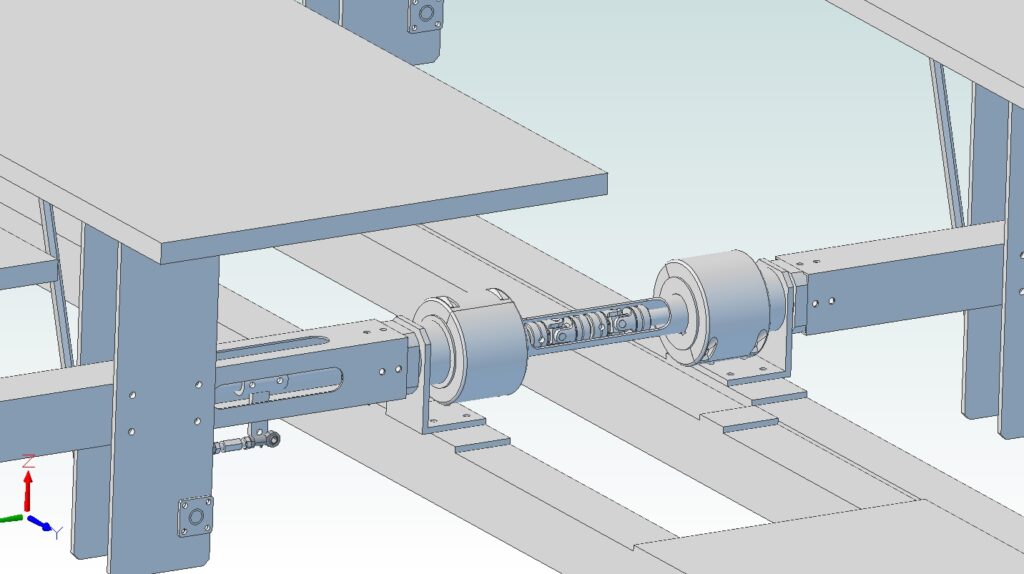
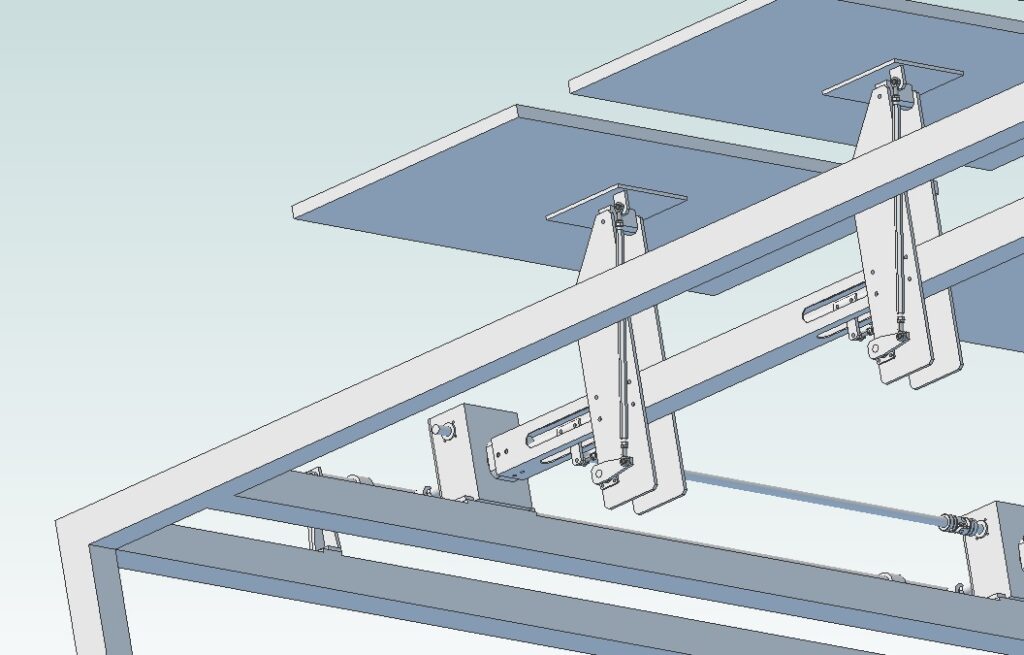
The proposed mechanism mainly consists of the following elements:
- Supporting Frame
Forms the skeleton of the system, with multiple frame bars arranged in parallel. Each frame bar holds multiple supporting units, ensuring structural rigidity. - Supporting Units
Each unit individually carries a solar panel and is placed at intervals along the frame bars. This allows multiple panels to be evenly and independently supported. - Rotating Mechanism
The core part of the system, composed of two axis rotation mechanisms:- First-Axis Rotation Mechanism (X-axis)
Rotating components linked to the frame bars allow multiple panels to rotate simultaneously, tracking the sun’s east-west movement.
The rotation angle is automatically adjusted by the control unit.
- Second-Axis Rotation Mechanism (Y-axis)
Rotating arms linked to sliding rods inside the frame bars allow panels to tilt forward or backward simultaneously, adjusting to the sun’s altitude angle.
- First-Axis Rotation Mechanism (X-axis)
- Drive and Control Unit
Uses sensor data to calculate sun position and drives motors or actuators to rotate panels along both axes.
Maintains the perpendicular incidence of sunlight and, in bad weather, automatically reverses or retracts panels for protection.
5. Operation and Control Principle
The system calculates rotation angles for both X-axis and Y-axis based on solar azimuth and altitude.
Actuators drive multiple panels synchronously, maintaining maximum sunlight incidence.
During sunset or high wind, the panels are moved to horizontal or reversed positions to protect equipment and enhance maintenance safety.
6. Technical Features and Advantages
| Feature | Technical Detail | Effect |
| Solar Tracking Control | Dual-axis automatic tracking | Maximizes solar incident light, improves power generation efficiency |
| Synchronous Rotation | Multiple panels controlled simultaneously | Easy application to large-scale systems |
| Protective Mechanism | Automatic reversal/retreat under bad weather | Extends panel lifespan, increases safety |
| Versatile Design | Suitable for land and water installation | Allows use in diverse environments |
| Maintenance | Modular replacement possible | Reduces operational costs |
7. Potential Applications
- Large-scale solar farms (ground installation)
- Floating photovoltaic systems
- Building-integrated photovoltaic systems (BIPV)
- Smart grid or integrated energy facilities
Its design is resistant to weather and terrain limitations, enabling stable power generation in high-latitude regions or areas with large seasonal changes.
8. Conclusion
The proposed solar panel supporting and rotating mechanism overcomes the limitations of conventional fixed frames, integrating solar tracking, angle adjustment, and automatic protection.
By maintaining optimal sunlight incidence, it enhances power conversion efficiency and contributes to expanding the utilization of renewable energy.
This mechanism represents a core technology for next-generation solar power systems, expected to support sustainable energy use and environmental conservation.